

Welcome to the 99th edition of DevShorts, Dev Catch Up.
For those who joined recently or are reading Dev Catch Up for the first time, I write about developer stories and open source, partly based on my work and experience interacting with people all over the globe.
Thanks for reading Dev Shorts! Subscribe for free to receive new posts and support my work.
Some recent issues from Dev Catch up:
Join 8700+ developers to hear stories from Open source and technology.
Must Read
Google has released Gemini 3.1 Pro. It brings better reasoning, stronger coding and longer context. It is now available in public preview across AI Studio, the Gemini API, Antigravity, and other Google platforms. Check Google’s announcement on Gemini 3.1 Pro for details.
Anthropic has released Claude Sonnet 4.6, the most capable Sonnet model yet. It improves coding, reasoning, agent planning, and computer use. It also supports a 1M token context window in beta. Pricing remains the same as Sonnet 4.5. Check Anthropic’s announcement on Claude Sonnet 4.6.
Alibaba has released Qwen 3.5. This is the first open weight model in the Qwen 3.5 series, named Qwen3.5 397B A17B. It is a native vision language model. It performs well on reasoning, coding, agentic tasks, and multimodal understanding. They also introduced Qwen3.5 Plus, a cloud hosted version. Check the Qwen 3.5 announcement for details.
Elon Musk announced Grok 4.2. It has been used internally for research and is now rolling out to the public. It can learn rapidly from every task it handles. Updates are expected weekly, along with release notes. Check the Grok 4.2 announcement on X for details.
OSS Highlight of the Week
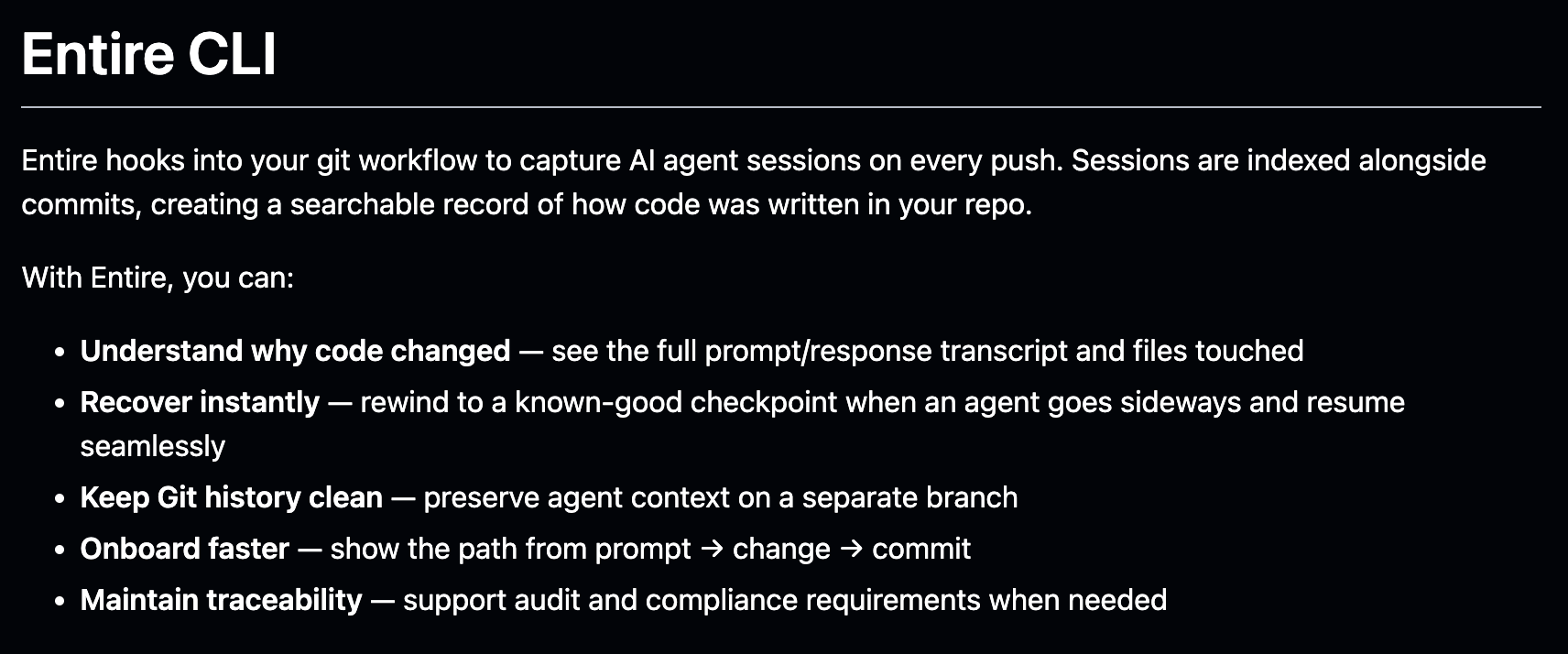
This week we are featuring Entire CLI. It hooks into git and captures AI agent sessions on every push. It saves the prompt and response history along with the commit, so you can see why code changed. It also lets you rewind to a checkpoint when an agent goes wrong. Check the Entire CLI GitHub repo for details.
Good to know
OpenAI introduced Lockdown Mode in ChatGPT. It is an optional setting that reduces risk from prompt injection by limiting risky connections. They also added Elevated Risk labels to flag higher risk features. Check OpenAI’s announcement for details.
A detailed deep dive breaks down how Codex is built from the ground up. It covers how Codex started, how it works, the most used skills in Codex, and even how Codex helped build itself. Check the substack post to know interesting details about codex.
NotebookLM added prompt based revisions for slides. You can refine a deck with simple prompts. It also supports PPTX export now. Google Slides export is coming next. This should make it easier to move from notes to a shareable deck faster. Check the NotebookLM post for details.
Manus introduced Manus Agents for messaging apps. Telegram is the first supported channel. It is available now for all users across all subscription tiers, and more platforms are coming soon. Check the Manus announcement for details.
Chrome introduced WebMCP in early preview. It gives websites, a standard way to expose structured tools. So AI agents can interact with sites directly in a faster and more reliable way. Check the Chrome Developers post for details.
Notable FYIs
Andrej Karpathy shared a new project called microgpt. It trains and runs a GPT in a single Python file. The file is about 200 lines with no dependencies and includes the core pieces like tokenizer, model, training, and inference. Check Andrej Karpathy’s microgpt post for details.
Excalidraw now has an official MCP server. You can use it in Claude by selecting Excalidraw in Connectors. You can also use it with other AI tools. Check the Excalidraw post for details.
Google has launched Code Wiki. It turns your repository into auto generated documentation and diagrams. It updates docs when code changes and lets you chat with the repo using Gemini. It is now in public preview for open repositories. Check Code Wiki for details.
Google has released Lyria 3. It is their latest generative music model. It can create a 30 second soundtrack with lyrics from your prompt. It is now available in the Gemini API. Check Google’s announcement on Lyria 3 for more details.
Cursor introduced Plugins. It is now available in the Cursor Marketplace. You can install integrations like Figma, Linear and others, and use them through MCP inside the IDE, CLI, and Cloud. Plugins can bundle rules, skills, agents, commands, MCP servers, and hooks into one package. Check the Cursor Plugin Marketplace for details.
That’s it from us with this edition. We hope you are going away with a ton of new information. Lastly, share this newsletter with your colleagues and pals if you find it valuable. A subscription to the newsletter will be awesome if you are reading it for the first time.