

Welcome to the 115th edition of DevShorts, Dev Catch Up.
For those who joined recently or are reading Dev Catch Up for the first time, I write about developer stories and open source, partly based on my work and experience interacting with people all over the globe.
Thanks for reading Dev Shorts! Subscribe for free to receive new posts and support my work.
Some recent issues from Dev Catch up:
Join 8900+ developers to hear stories from Open source and technology.
Must Read
Moonshot AI has released Kimi K3, a 2.8T-parameter model. It is built for coding and agentic tasks. It supports native vision and a 1M-token context window. The full model weights will be released by July 27, 2026. Check Kimi’s post for more details.
Thinking Machines Lab has released Inkling, a new open-weights model. The MoE Model has 975B total params, 41B active params. It can work with text, images, and audio. It supports 1M-token context window. The weights are on Hugging Face. Check Thinking Machines Lab’s post for more details.
SpaceXAI has launched Grok 4.5. SpaceXAI says this is its strongest model so far. It was trained alongside Cursor. It is built for coding, agentic tasks, and real engineering tasks. The model is good at creating well-designed, end-to-end apps. Check SpaceXAI’s post for more details.
PrismML has released Bonsai 27B, a compressed multimodal model based on Qwen3.6. Its 3.9 GB 1-bit version can run on an iPhone 17 Pro, while the 5.9 GB version targets laptops. Both versions support reasoning, vision, and tool calls on local devices. Check PrismML’s post for more details.
OSS Highlight of the Week
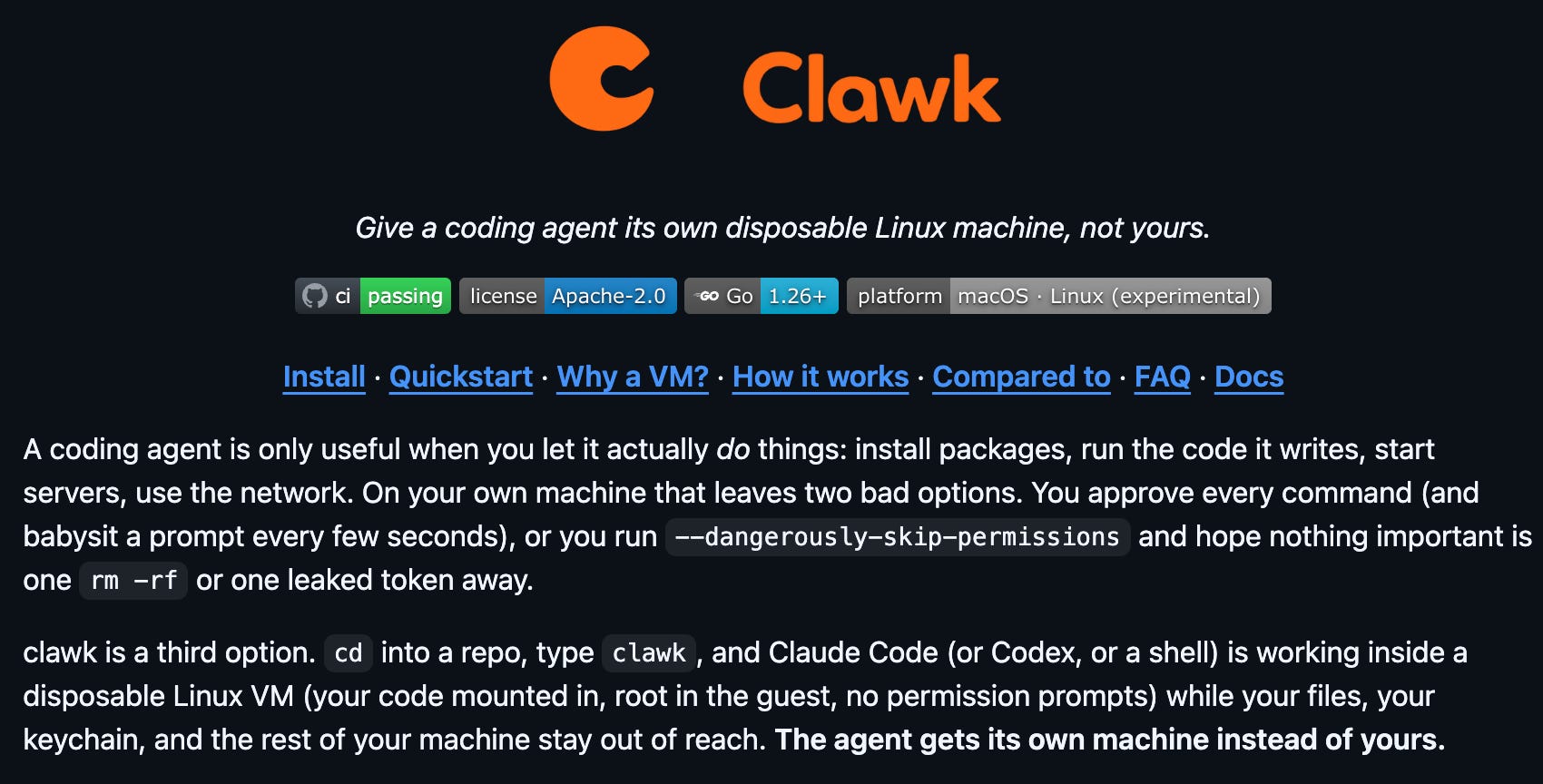
This week, we are featuring Clawk. It is an open source tool that gives coding agents a disposable Linux VM. It works with Claude Code, Codex, and shell sessions. The agent gets root access inside the VM. Your keychain and unmounted files stay outside it. Network access is controlled through an allow-list. Check the GitHub repo for setup details.
Good to Know
Google Antigravity has added Agent Teams as a research preview. The /teamwork-preview command starts a team of specialized subagents. They work together to plan, build, and verify coding tasks in parallel. This feature is limited to Google AI Ultra users. Check Antigravity’s post for more details.
Parallel has launched Search Turbo, a new fast mode for its web search API. It returns web results that AI models can use directly. This can be useful for applications that need fast web search. Check Parallel’s post for more details.
Meta has launched Muse Image and Muse Video. Muse Image can edit images and combine elements from multiple references. It can search the web for current information and improve its own output. Muse Video can generate videos with native audio. Check Meta’s post for more details.
Passmark is an opensource Playwright library. It covers end-to-end browser testing. You can write browser test steps in natural language. It uses AI models to execute those steps through Playwright. Check the GitHub repo for setup details.
Reve has launched the Reve 2.1 API. It can create and edit native 4K images. It also includes experimental APIs for working with layouts. A layout splits an image into editable regions. Developers can change one region without changing the rest of the image. Check Reve’s post for more details.
We are covering more resources on harness engineering. Here is another one on harness engineering by Lilian Weng. The guide covers workflow automation, file-based memory, subagents, and self-improving harnesses. Read the full post for more details.
Notable FYIs
OpenAI has launched GPT-Live, a new voice model for natural conversations. It can listen and speak at the same time. For harder questions, it can send search and reasoning tasks to GPT-5.5 while the conversation continues. The API is planned for a later release. Check OpenAI’s post for more details.
Cognition has released SWE-1.7, its most capable coding model so far. It is built for long-running software engineering tasks. When the model approaches its context limit, it summarizes its current work and continues from that summary. Check Cognition’s post for more details.
SpaceXAI has open sourced Grok Build, its coding agent harness and terminal UI. It shows how it assembles context, handles model responses, and runs tool calls. It also includes support for skills, plugins, hooks, MCP servers, and subagents. Check the GitHub repo for more details.
Meta has released Muse Spark 1.1, a multimodal reasoning model for agentic tasks. It has a 1M-token context window. It can compact older work while keeping important steps. It also supports planning and parallel subagents. Check Meta’s post for more details.
Mellea is an open source Python library for building structured LLM workflows. It turns Python functions into LLM calls. Docstrings become prompts, and type hints define the output format. It checks the result and retries if the requirements are not met. Check the GitHub repo for setup details.
That’s it from us with this edition. We hope you are going away with a ton of new information. Lastly, share this newsletter with your colleagues and pals if you find it valuable. A subscription to the newsletter will be awesome if you are reading it for the first time.