

Welcome to the 111th edition of DevShorts, Dev Catch Up.
For those who joined recently or are reading Dev Catch Up for the first time, I write about developer stories and open source, partly based on my work and experience interacting with people all over the globe.
Thanks for reading Dev Shorts! Subscribe for free to receive new posts and support my work.
Some recent issues from Dev Catch up:
Claude Certified Architect Foundations: The Complete Guide - Part 1
Claude Certified Architect Foundations: The Complete Guide - Part 2
Join 8900+ developers to hear stories from Open source and technology.
Must Read
Microsoft AI has launched seven models. The new family covers reasoning, code, image, transcription, and voice. Among them, MAI Thinking 1 is a reasoning model trained from scratch for STEM reasoning and coding tasks. Check Microsoft’s post for more details.
Hermes Agent now has a native desktop app. It brings Hermes Agent to a simple desktop app, without needing the terminal. Users still get the same agent, memory, and skills. Check the Hermes Desktop page for download details.
Google has released Gemma 4 12B. It is an open weight model built for agentic workflows. It supports text, vision, and native audio inputs. It is laptop ready and can run locally with 16GB memory. Check Google’s post for more details.
NVIDIA has released Nemotron 3 Ultra. It is their most capable Nemotron model so far. It supports up to 1M context and gives better control over reasoning during inference. NVIDIA is also releasing the model checkpoints, training datasets, and recipes. Check NVIDIA’s post for more details.
OSS Highlight of the Week
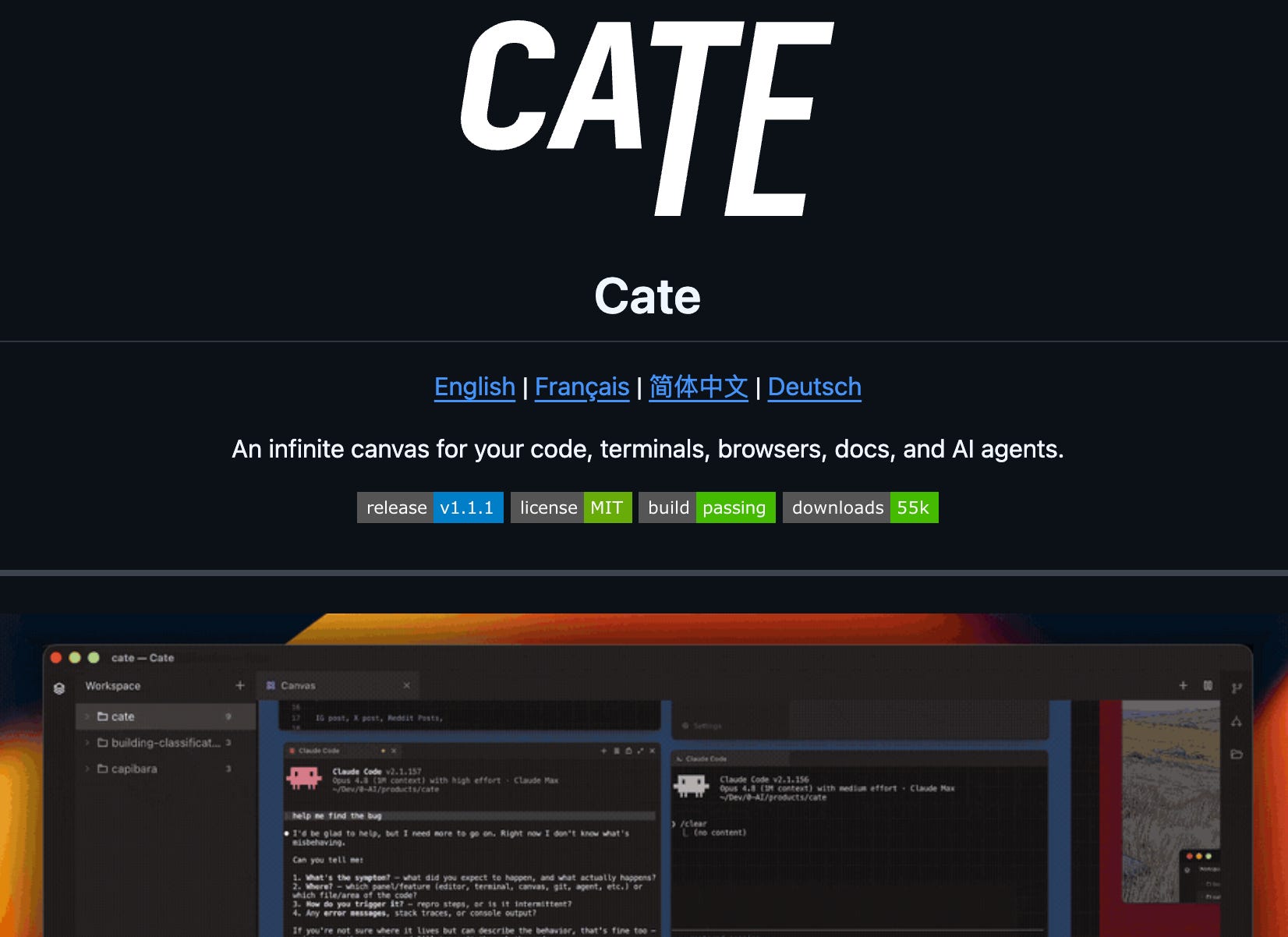
This week we are featuring Cate. It is an infinite zoomable canvas for coding. You can keep your editor, terminal, browser, docs, and AI agents in one workspace. It helps you work on a project without switching between too many windows. Check the GitHub repo for more details.
Good to know
OpenAI is taking Codex beyond coding. Sites are a new canvas where Codex can turn ideas into dashboards. They also shipped plugins for areas like sales, product design, analytics, and finance. Each plugin brings the needed apps, skills, instructions, and workflows together. Check OpenAI’s Codex post for more details.
Anthropic released Claude Opus 4.8 last week. Whenever an Opus model gets released, expectations are usually high. Opus 4.8 brings better coding performance, effort control, cheaper Fast mode, and parallel subagents in Claude Code. Check Anthropic’s announcement for more details.
Meta has introduced Meta Business Agent. It helps businesses handle customer conversations on WhatsApp, Messenger, and Instagram. It can answer questions, suggest products, and book appointments. It uses AI to give more personalized support to customers. Check Meta’s post for more details.
Cloudflare cofounder Matthew Prince says bot traffic has now crossed human traffic on the internet. He says this happened faster than he expected because agentic traffic is growing quickly. This shows how AI agents are starting to change web traffic. Check the post for more details.
xAI has rolled out Grok Imagine 1.5 Preview. It is the latest image and video generation model from xAI. It supports up to 2K image output, 10 images per request, and videos up to 15 seconds. Check xAI’s Imagine API page for more details.
Notable FYIs
Anthropic released dynamic workflows in Claude Code. Claude can now write its own harness on the fly for complex tasks. Since dynamic workflows may use more tokens, it is better to use them only when needed. Check Anthropic’s blog for example prompts and more details.
Qwen has released Qwen3.7 Plus. It is their latest multimodal agentic model. It is built for agentic tasks like screen understanding, GUI tasks, and browser workflows. It can also navigate mobile apps and complete tasks. Check Qwen’s post for more details.
MiniMax has released MiniMax M3. It is an open weight model built for coding and agentic tasks. It supports image and video input, computer use, and 1M context. MiniMax says it is the first open weight model to bring all these together. Check MiniMax’s M3 post for more details.
NVIDIA has released the open weight Cosmos3 model. It is a collection of world models built for Physical AI. It can be used for robotics, autonomous vehicles, and smart spaces. Check the Hugging Face model card for more details.
Hugging Face has open sourced Trackio. It is a simple alternative to Weights and Biases. You can run it locally and track your experiments without setting up a hosted tool. Check the GitHub repo for more details.
OpenAI models, Codex, and Managed Agents are now available on AWS. AWS customers can use OpenAI models through Amazon Bedrock. This makes it easier for enterprises to use OpenAI inside their existing AWS setup. Check OpenAI’s post for more details.
That’s it from us with this edition. We hope you are going away with a ton of new information. Lastly, share this newsletter with your colleagues and pals if you find it valuable. A subscription to the newsletter will be awesome if you are reading it for the first time.