

Welcome to the 110th edition of DevShorts, Dev Catch Up.
For those who joined recently or are reading Dev Catch Up for the first time, I write about developer stories and open source, partly based on my work and experience interacting with people all over the globe.
Thanks for reading Dev Shorts! Subscribe for free to receive new posts and support my work.
Some recent issues from Dev Catch up:
Join 8800+ developers to hear stories from Open source and technology.
Must Read
Google DeepMind has introduced AI Pointer. You can point to something on your screen and ask Gemini to act on it. It understands what you are pointing at, so you don’t need long prompts. It also supports voice, text, and images. Check Google DeepMind’s post for more details.
OpenAI has brought Codex to the ChatGPT mobile app. You can track tasks, review outputs, and guide Codex from your phone. Your files and credentials stay on the machine where Codex is running, while updates come to your phone in real time. Check OpenAI’s post for more details.
OpenClaw’s Peekaboo is worth checking if you are exploring screen based agents. It helps AI agents capture screens, understand what is on them, and automate GUI actions. It works as both a CLI and MCP server for Codex, Claude Code, and Cursor. Check the Peekaboo GitHub repo for more details.
Thinking Machines Lab has introduced interaction models. The idea is to make AI conversations feel more natural and live. The interesting part is the architecture. One model stays responsive during the live conversation, while a background model handles reasoning, search, and tool use. Check Thinking Machines Lab’s post for more details.
OSS Highlight of the Week
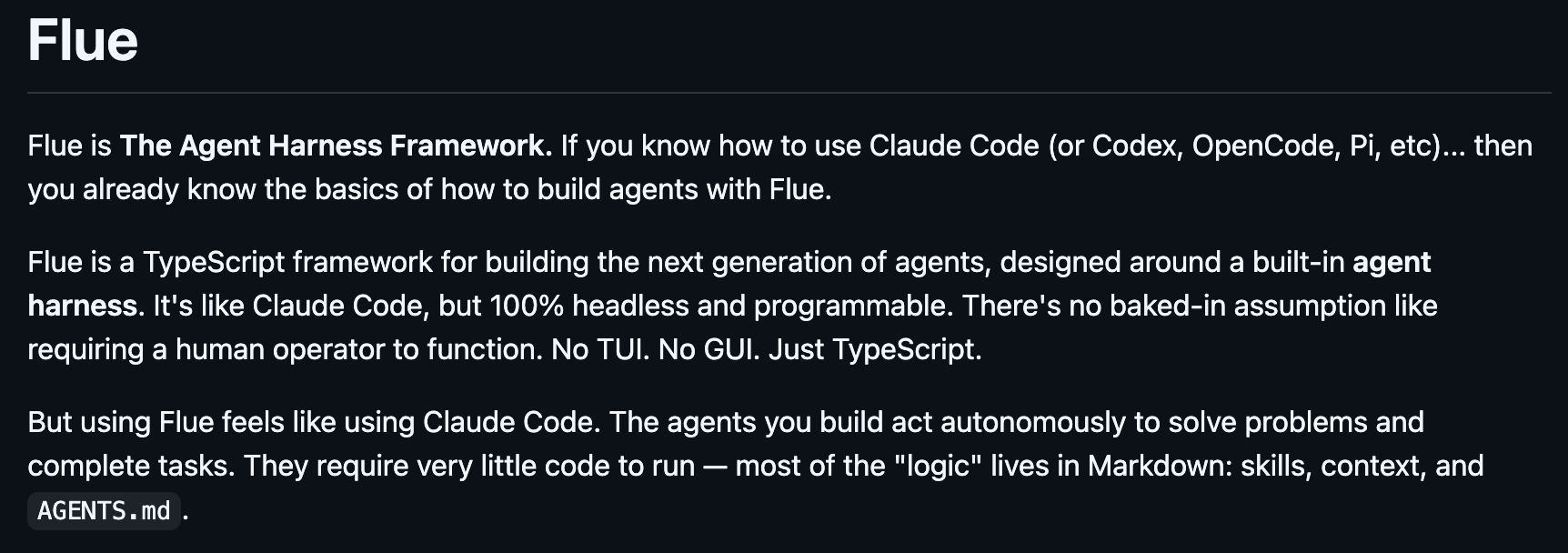
This week we are featuring Flue. It is an agent harness framework for building headless and programmable agents. Think of it like Claude Code, but without the terminal UI or human operator. It supports sandboxes, sessions, skills, MCP tools, and deployment across runtimes. Check the Flue GitHub repo for more details.
Good to know
Claude Code now supports /goal. You can give a task with a clear goal. Claude will keep working until that goal is done. A small evaluator model checks the progress after each turn. Check Claude Code docs for more details.
Claude Platform is now available directly on AWS. AWS customers can now use more Claude capabilities, beyond Bedrock models. It includes Claude Managed Agents, code execution, web search, Skills, MCP, and more. Check Claude’s post for more details.
OpenAI has introduced Daybreak for cybersecurity. It brings GPT 5.5 and Codex Security into security workflows. It helps teams review code, find risks, validate patches, and fix issues faster. The goal is to bring AI earlier into secure software development. Check OpenAI’s Daybreak page for details.
I came across Thariq’s post on using HTML instead of Markdown for agent outputs. Markdown works well for simple notes, but large outputs can become hard to read. HTML can show the same content with better visuals and richer information. His collection has 20 HTML examples generated by agents. Check the post and collection for more details.
Notable FYIs
Google has released Agent Skills for Google products. It includes skills for BigQuery, Cloud Run, Firebase, GKE, and more. It also covers Google Cloud onboarding, authentication, and network observability. Check the Google Skills GitHub repo for more details.
If you are using AI coding agents and want to know where your tokens are going, check CodeBurn. It shows usage across Claude Code, Codex, and Cursor. It also breaks usage down by task, tool, model, and project. You also get an interactive terminal dashboard for cost visibility. Check the CodeBurn GitHub repo for more details.
xAI has released Grok Build. It is a coding agent that runs from the terminal. It comes with familiar coding agent features like plans, skills, plugins, hooks, and parallel subagents. Check xAI’s Grok Build page for more details.
Claude Code now has Agent View. It helps you manage many Claude Code sessions from one place. You can see which agents need input, which are still working, and which are done. It is useful if you run multiple coding agents in parallel. Check Claude’s blog for more details.
Mirage is a virtual filesystem for AI agents. It gives agents one common way to access tools like S3, Google Drive, Slack, Gmail, and more. Agents can use simple file commands instead of separate APIs. Check the Mirage GitHub repo for more details.
Higgsfield has released Supercomputer. It is an AI agent for creating ads, product shots, marketing content, and campaigns. You can describe what you want, and it picks the right model for the task and gets the work done. Check Higgsfield’s post for more details.
That’s it from us with this edition. We hope you are going away with a ton of new information. Lastly, share this newsletter with your colleagues and pals if you find it valuable. A subscription to the newsletter will be awesome if you are reading it for the first time.