

Welcome to the 117th edition of DevShorts, Dev Catch Up.
For those who joined recently or are reading Dev Catch Up for the first time, I write about developer stories and open source, partly based on my work and experience interacting with people all over the globe.
Thanks for reading Dev Shorts! Subscribe for free to receive new posts and support my work.
Some recent issues from Dev Catch up:
Join 8900+ developers to hear stories from Open source and technology.
Must Read
Meta has released Muse Code and Muse Spark 1.2. Muse Code is a terminal coding agent powered by Muse Spark 1.2. Meta co-trained the model and agent for long coding tasks. Muse Code includes skills for planning, testing, and completing the task. If it crashes, it can resume exactly where it stopped. Check Meta’s post for more details.
Qwen has released Qwen3.8-Max. It is a 2.4T-parameter MoE model. It supports text, images, video, and a 1M-token context window. Qwen says it can work autonomously on coding projects for more than 10 days. Its open weights will be released next week. Check Qwen’s post for more details.
Prime Intellect has introduced Prime Agent, a self-improving harness for coding and long-running tasks. It is designed to use tokens efficiently. It supports tool calls and communication between agents. It can also update its harness state while working. Check Prime Intellect’s post for more details.
Pokee AI has released Pokee-Isaac 28B, an agentic model with a 10M-token context window. Pokee AI says it performed well on benchmarks for tool use, agentic tasks, and security. Check Pokee AI’s post for more details
OSS Highlight of the Week
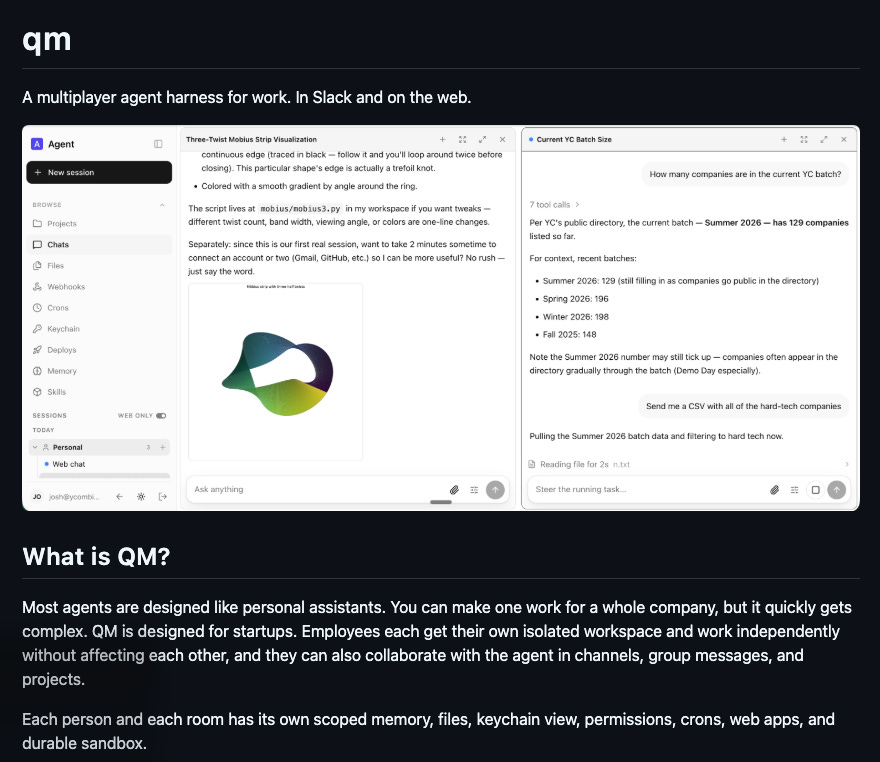
This week, we are featuring QM. It is an open source agent harness designed for startups. Each employee gets an isolated workspace with their own memory, files, and permissions. Employees can work independently without affecting others. They can also collaborate with the agent in Slack channels and projects. QM supports Pi, OpenCode, Codex, and Claude Code. Check the GitHub repo for setup details.
Good to Know
Anthropic plans to offer in-country inference for Claude in India, according to ETtech. Claude requests will be processed on servers in India. This will allow the data to stay within the country. ETtech says this will be available in the coming weeks. Check ETtech’s post for more details.
OpenAI has reduced the API prices for GPT-5.6 Luna and Terra. Luna is now 80% cheaper, while Terra is 20% cheaper. In ChatGPT, Luna is becoming the default for Free and Go users, while Plus and Pro users get the updated Sol. Check OpenAI’s posts for more details.
Cloudflare has open sourced Cloudflare OS. It was originally built for its own employees to use AI at work. It is not a traditional computer OS. It includes an agent chat interface, sandboxes for building apps, and a security framework for controlling access. Check the GitHub repo for setup details.
Mistral AI has released Shieldstral 1.0 3B, an open-weight model for content moderation. Developers can describe a safety policy in natural language. The model then checks text and images against that policy. You can change the policy without retraining the model. Check the Mistral’s post for more details.
Firecrawl has released AnyDoc, an open source Rust library that converts documents into Markdown. It supports Word, PowerPoint, Excel, and text-based PDF files. It also ships as a skill for coding agents. Check the GitHub repo for setup details.
Notable FYIs
Gemma Translator is an open source voice translator built by Google. It listens to speech, translates it using Gemma 4, and speaks the result in another language. It runs fully offline after setup. It is designed for a Raspberry Pi 5 with 8 GB of RAM. Check the GitHub repo for setup details.
Thinking Machines Lab has released Inkling-Small, a smaller open-weights version of Inkling. The MoE model has 276B total parameters and 12B active parameters. It supports text, images, audio, and a 1M-token context window. Thinking Machines says it offers similar performance to Inkling with less compute. Check Thinking Machines’s post for more details.
Black Forest Labs has released FLUX 3 Video. It can create videos from text or images. It generates clips up to 20 seconds with dialogue, sound effects, and ambient sounds. It also supports keyframes and can continue an existing video. Check Black Forest Labs’s post for more details.
SpaceXAI has released Grok Voice Think Fast 2.0, its latest speech-to-speech voice model. It improves transcription, conversations, and tool use. SpaceXAI says it starts responding in about 0.7 seconds. It is also built to handle background noise and phone audio. Check SpaceXAI’s post for more details.
Google has released Lyria 3.5, its latest music generation model. It improves melodies, lyrics, vocals, and pronunciation. Users can also control the tempo and duration of generated tracks. It is available in Google Flow Music. Check Google’s post for more details.
Cloudflare has introduced @cloudflare/computer, an open source runtime for AI agents. It gives filesystem and tools to agents to work with its files. Simple tasks run in a Worker. Complex tasks run in a container. Both environments use the same files, so the agent can switch between them without losing its work. Check Cloudflare’s post for more details.
That’s it from us with this edition. We hope you are going away with a ton of new information. Lastly, share this newsletter with your colleagues and pals if you find it valuable. A subscription to the newsletter will be awesome if you are reading it for the first time.