

We see coding agents everywhere now.
AI coding agents can pick up a task, build the code, test it, review it and raise a PR. In a JetBrains survey, developers said that around 47% of their code was AI generated. Microsoft CEO Satya Nadella also said that around 30% of their company’s code was written by AI.
After companies started using coding Agents, they started shipping more commits.


So Coding Agents are helping engineering teams to ship more. But now, something beyond these individual Agents has started getting attention.
It is called Dark Factory/Software Factory.
In a Dark Factory, AI agents handle software development end to end. They begin with planning and continue working until the feature goes live.
But how these Agents work together? Can we really allow them to work on code end to end?
Let us understand all these in this blog.
This blog covers,
What is Dark Factory
Coding Agents vs Dark Factory
Inside OpenAI’s Software Factory
Uber’s Software Factory
Other Software Factory Examples
What Was Built Using a Software Factory?
Can Agents deploy without human review
Problems and limitations of Dark Factories
Sponsored by CodeAF
CodeAF is a new open-source coding harness built for open models.
In DeepSWE benchmark, CodeAF solved 2x as many issues as OpenCode and nearly 4x as many as Claude Code using the same open model.
CodeAF is also cheaper when compared to OpenCode and Claude Code. It costs 4.8x less than OpenCode and 3.4x less than Claude Code for every solved issue.

It is built for open models such as DeepSeek, Qwen, GLM and Kimi.
But there is no vendor lock-in. It also works with closed models and any provider you choose.
1. What is Dark Factory?
First, why this name Dark Factory?
It actually came from manufacturing. There are factories where machines and robots handle most of the work. Humans are not required inside all the time. So even the lights can be turned off. Machines will still continue their work.
That is why they are called Dark Factories or Lights Out Factories.
Now, the same term has entered software development. Usually, we give a coding agent one task. It builds the code, tests it, and raises a PR. Then, we check the PR and merge it.
But in Dark Factory (Software Factory), it is not about one task or one PR. We give the requirement. From there, agents take care of planning, coding, testing, review, and deployment. After the feature goes live, they can monitor it too.
So the requirement goes in. A live feature comes out. The picture below shows the Dark Factory flow.
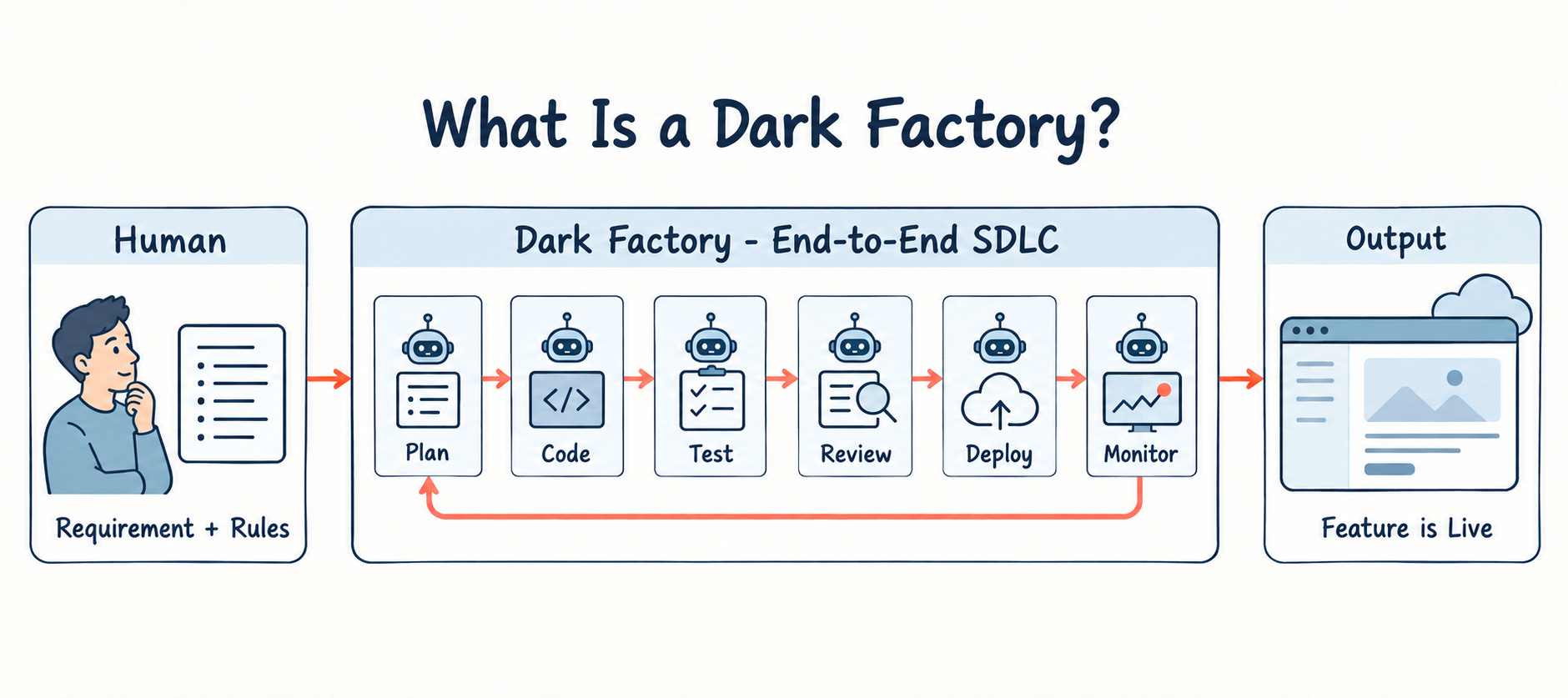
One question here is, what do humans do?
Dark Factory does not mean humans leave everything to AI Agents. Humans still decide/make decisions what needs to be built. They give the input and verify the output. But humans may not sit inside every step. They come in when the Agents are stuck or when the output needs to be checked.
When Agents build faster, this checking itself can become a verification bottleneck. We will see this later.
2. Coding Agent vs Dark Factory
The main difference between a Coding Agent and a Dark Factory is how much of the software development process they handle.
With an AI Coding Agent, a human decides what should happen next. In a Dark Factory, the work moves to other Agents for testing, review, deployment and monitoring. Humans come in only when the factory needs their help.
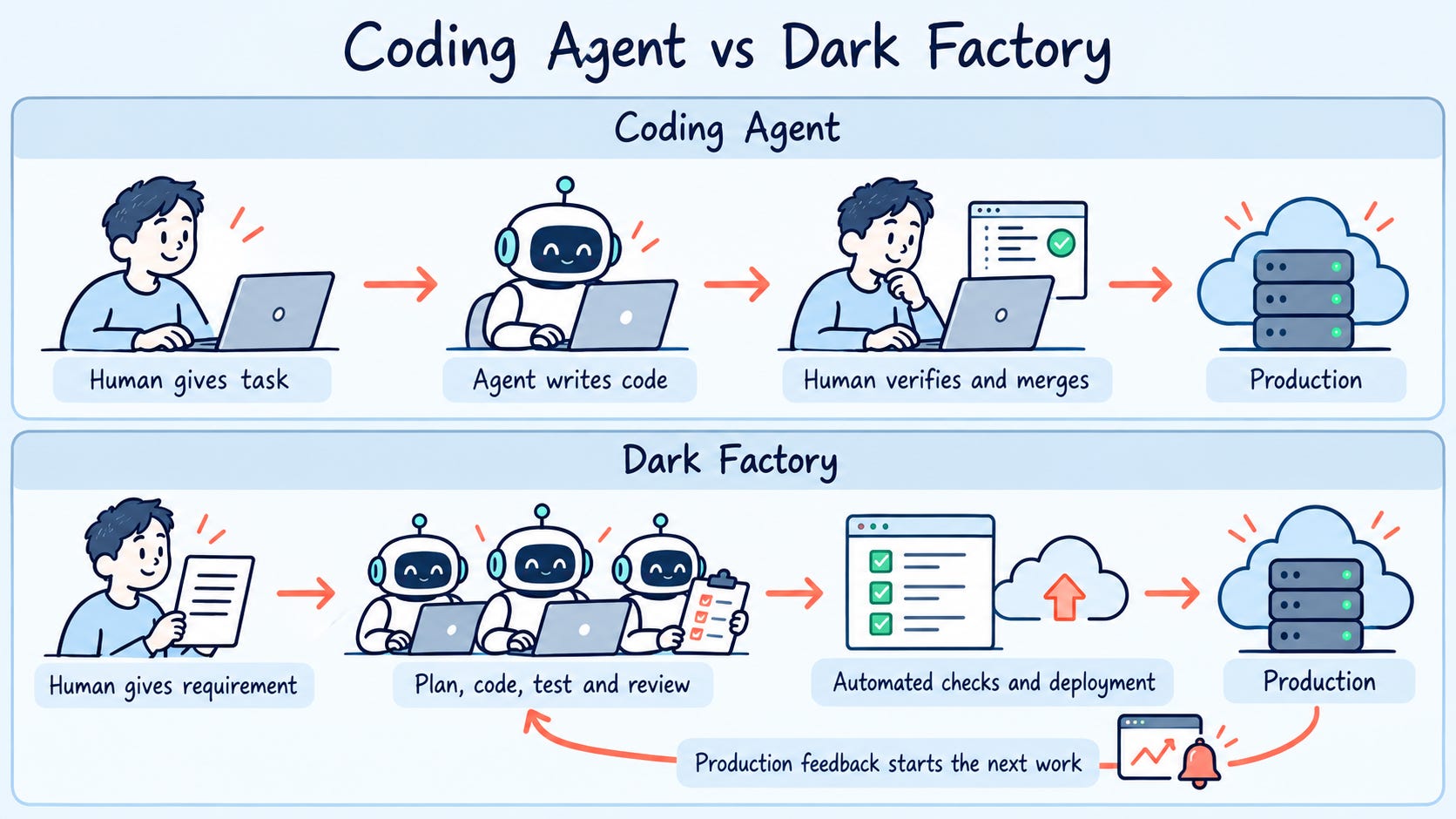
Now, let us see how OpenAI is running its Software Factory.
3. Inside OpenAI’s Software Factory
OpenAI’s Software Factory is built around Codex.
So what actually happens inside their Software Factory?
Gergely Orosz recently visited OpenAI and spoke with a few people there. After that, he shared how OpenAI’s Software Factory works.
When an engineer gives the requirement, Codex first collects the details. Then it writes the code, runs the tests and raises a PR. Then different agents will check and review the PR.
Once reviewed, if the change is low risk, an agent will approve it. Other changes will go to an engineer for review.
After approval, another Agent will deploy the change and check it until it goes live. It also creates a dashboard to check the change in production.
After deployment, they use something called Perf Factory. It checks the application for performance issues and suggests a fix. So if it finds a performance issue in production, the issue goes back into the development flow.
They also have an incident response Agent called Sevbot. It wakes up during an incident, collects the details and suggests possible actions in Slack. But Sevbot will not apply any fix by itself. An engineer has to choose the fix.
In future, OpenAI wants Sevbot to take care of common incidents without a human. So engineers do not need to wake up for every incident at night. But this is the future plan. Right now, engineers are still on call.

So OpenAI’s Software Factory, is running with less human involvement when compared to the normal SDLC flow. Because Codex and the other Agents built around it handle most of the work in between.
4. Uber’s Software Factory
Uber is also building its own Software Factory. More than 70% of its PRs are now contributed by its local and cloud Agents.
Inside this factory, Uber engineers have created more than 3,600 Agent skills. These skills are used more than 30,000 times every day. They are used for code review, fixing CI failures, testing, checking bugs, on call alerts and code maintenance.
One interesting thing here is, some Agent sessions are not started by humans. Managed Agents find the work and start on their own.
Running many Agents will cost more. So Uber tracks the cost of every Agent session. The below diagram shows the four layers of Agent usage at Uber and how they calculate the cost.

5. Other Software Factory Examples
OpenAI is not the only company working on this. We have other Software Factories running in real time.
Microsoft’s AI Software Factory
Researchers from Microsoft, GitHub and the University of Wisconsin shared their work on an AI Software Factory for Data Systems.
The below diagram shows how the factory can find work, change the code, review it and check the result in production.

This complete Software Factory- is their long term vision. As an early step, they built Autoperf for finding and fixing software performance issues. It is already used in tens of Microsoft repositories, with humans still reviewing the changes.
ONA’s Software Factory
We have one more example from ONA. Ona is a company that tested this kind of Software Factory with 16 automations.
The below image shows what ONA’s Software Factory did in 18 days.

And The below video shows a few flows inside ONA’s Software Factory.
We have one more example from StrongDM. You can read about their Software Factory here.
6. What Was Built Using a Software Factory?
We saw how these Software Factories work. But did any real product come out from them?
ONA built Memo during its Software Factory experiment. It is a Notion style notes application. Its entire code was written by AI Agents.
The repository is public. So we can see the code, commits and PRs created by the software factory.
The below image shows Memo’s commit history.
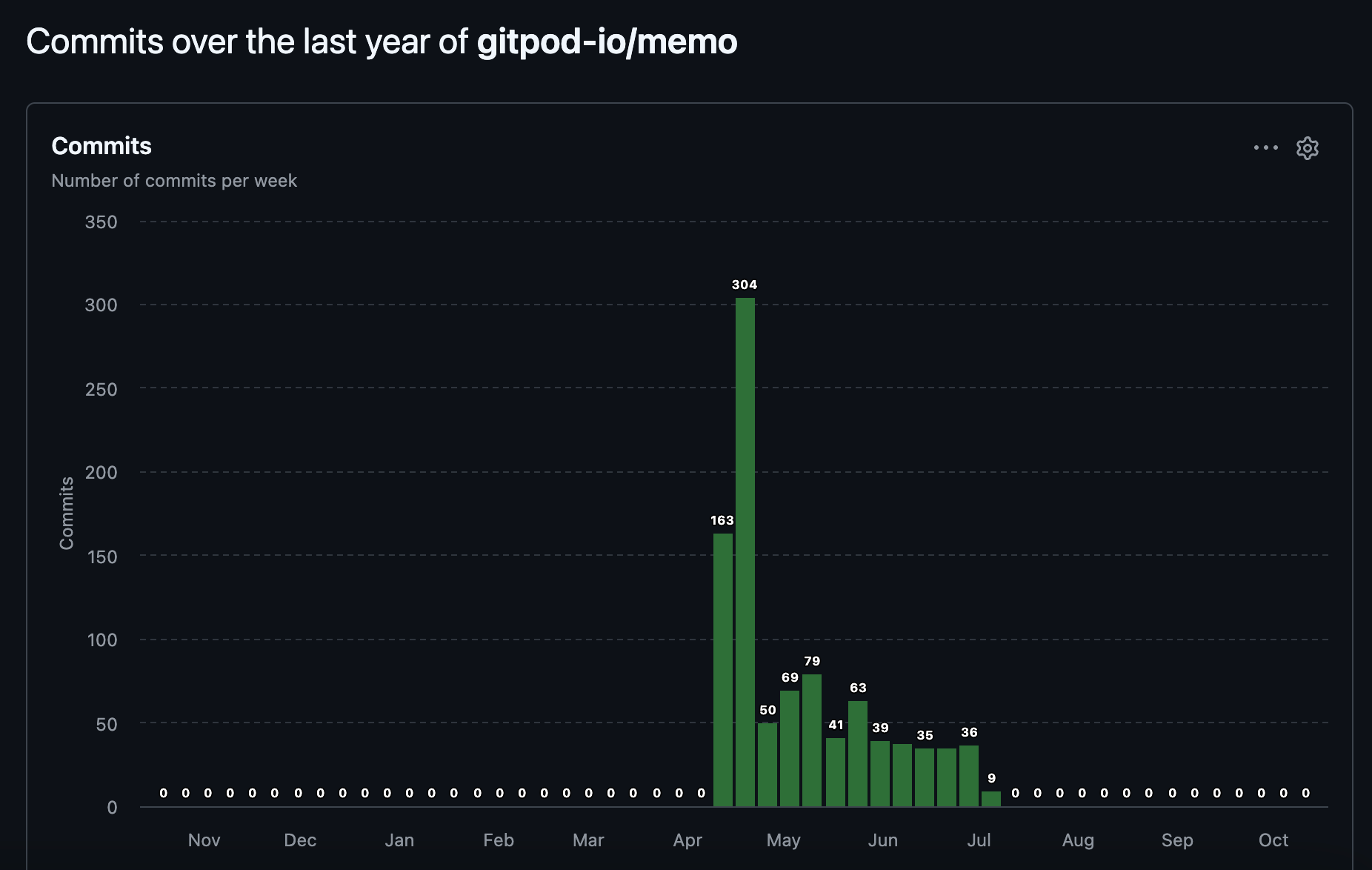
7. Can Agents Deploy Without Human Review?
Can Agents merge and deploy code without a human checking every change?
It is possible. But humans need to understand what is happening inside the factory. If something breaks, they should be able to find the issue and fix it.
For this, we need visibility, spot checks and verification.
Visibility: We need to see what agents are doing
For any change, we should be able to check the requirement, Agent decisions, code, tests and tool actions. This helps us understand how that change came in.
Spot Checks: We need to check changes
In a normal factory, we can pick one item and check it. The remaining work will continue.
We need the same option here. We should be able to pick any change and check what happened. Other Agents, should continue their work during this check.
Verification: We need to check the output
Agents can create PRs faster than humans can review them.
Tests alone are not enough here. Agent can write both the code and the tests. If the Agent understood the requirement wrongly, it can use that wrong understanding while writing the code and the tests. So all tests can pass, but the feature can still be wrong.
We need to check what we asked and what the Agent built. If not, the code review bottleneck will become a verification bottleneck.
So yes, Agents can deploy without a human checking every change. But only when we have enough visibility, spot checks and verification in place.
8. Problems and Limitations of Dark Factories
Dark Factories have many problems to solve. The below diagram, shows some of the problems companies faced while building and running them.
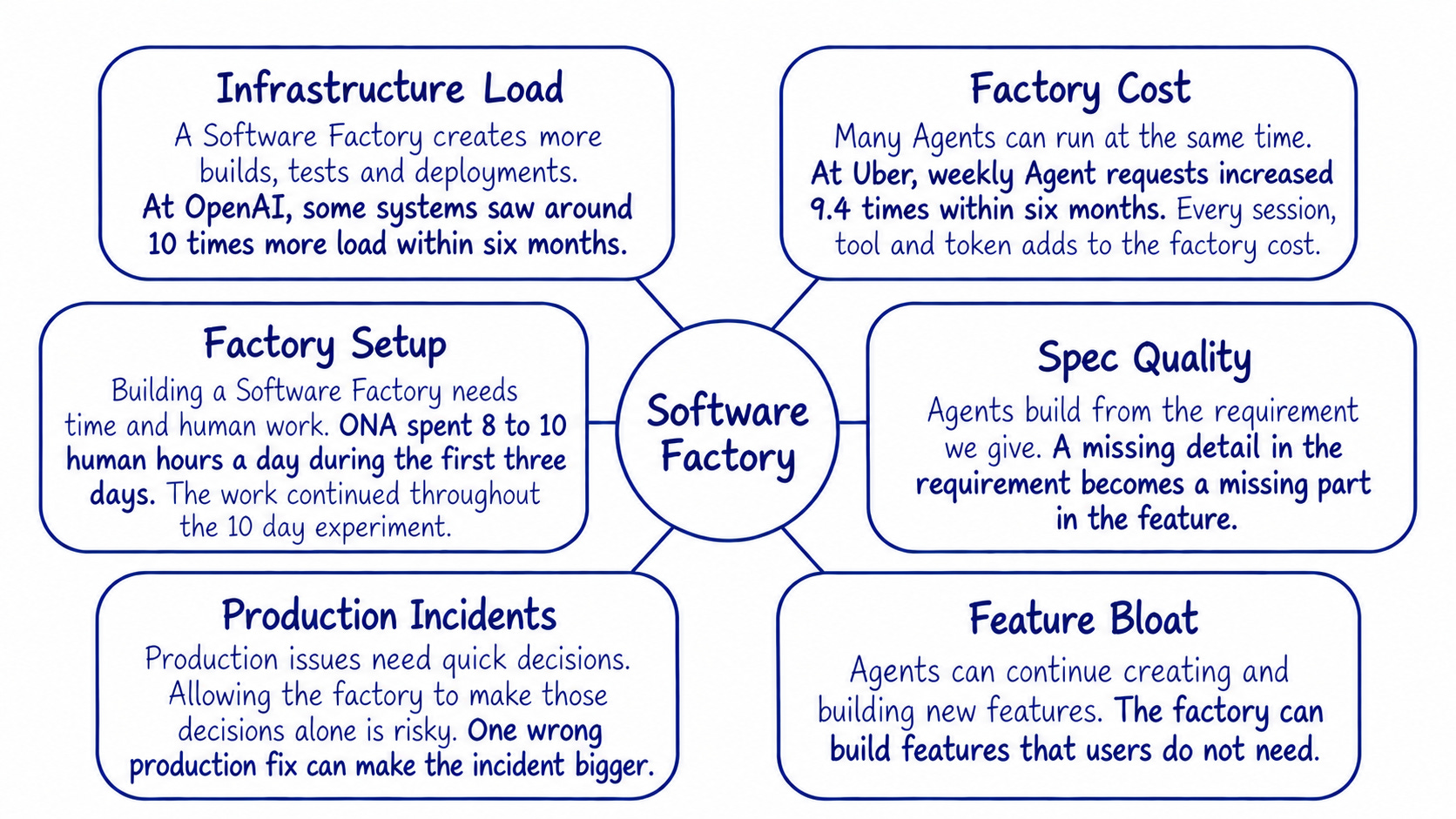
Conclusion
Dark Factory/Software Factory are still new in software development. We can build one and check how much work it can really handle without humans.
I believe this will happen. I do not have any doubt about it. But it may take some time.
Right now, Harness Engineering is mostly around one Agent. But a Software Factory has many Agents working together. So here, we need a bigger harness to connect all these Agents and control how they work.
This is the first post in our Dark Factory series. We will discuss more Software Factory concepts and practical examples in the upcoming posts.
Happy Building!