

Welcome to the 92nd edition of DevShorts, Dev Catch Up!
For those who joined recently or are reading Dev Catch Up for the first time, I write about developer stories and open source, partly based on my work and experience interacting with people all over the globe.
Thanks for reading Dev Shorts! Subscribe for free to receive new posts and support my work.
Some recent issues from Dev Catch up:
Join 8500+ developers to hear stories from Open source and technology.
Must Read
OpenAI has launched GPT 5.2. It is better at creating spreadsheets, building presentations, writing code, understanding images, and working with long context. It also uses tools more effectively and handles complex multi-step work with more accuracy. Read OpenAI’s GPT 5.2 post for more details.
Mistral has released its open-source agentic coding models and a new CLI agent. The model's name is Devstral 2. It comes in two sizes, 123B and 24B. Mistral also introduced a terminal coding agent. Check Mistral’s announcement on Devstral 2 and Vibe CLI for more details.
Claude Code can now get tasks directly from Slack. When you discuss bugs or feature requests in slack, you can tag @Claude to start a Claude Code session with the right context pulled from the chat. Read Claude Code and Slack post for more details.
Anthropic has introduced a new method called Selective Gradient Masking. It stores risky knowledge in a small part of the model during training, so it can be removed later without affecting overall performance. It points to a new way of building AI safety and control into the training process itself. Read the paper on selective-gradient-masking for more details.
OSS Highlight of the Week
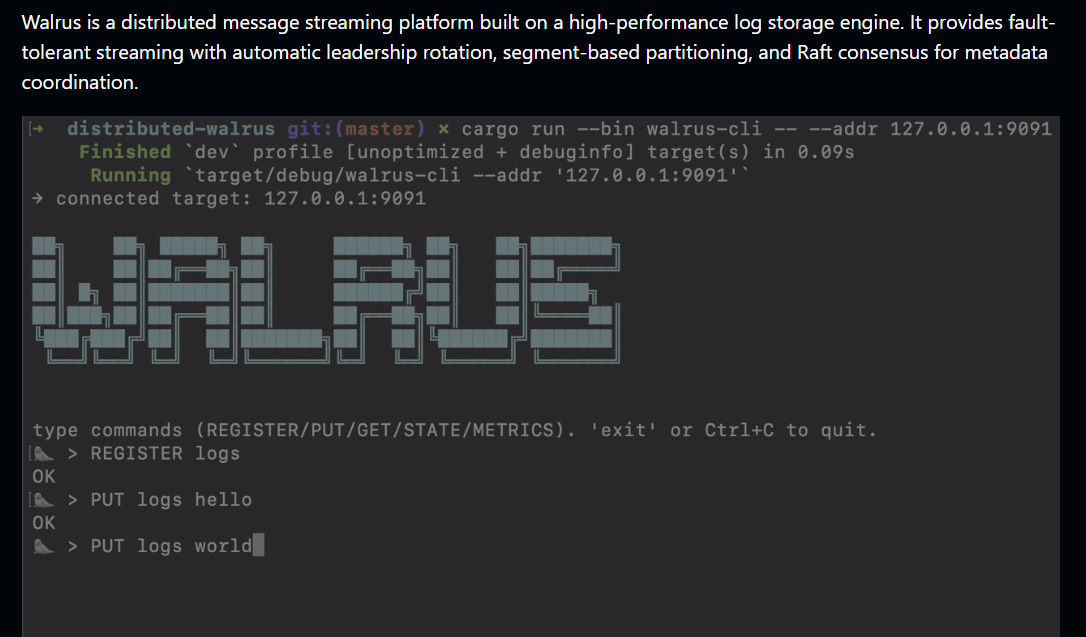
This week we are featuring Walrus. It is an open-source message streaming platform and an alternative to Kafka. Key features include high performance, automatic load balancing, fault tolerance and auto forwarding. Check the Walrus GitHub repo to know more details.
Good to know
IBM is acquiring Confluent in a deal valued at $11 billion. The acquisition values Confluent at $31 per share. Confluent is known for its real time data streaming platform built on Kafka. Read the post on IBM acquiring Confluent to know more details.
Google has released the Gemini Deep Research agent for developers through the Interactions API. It uses Gemini 3 Pro to handle agentic research tasks end to end. Check Google’s blog on the Deep Research agent for more details.
OpenAI, Anthropic, and Block have formed the Agentic AI Foundation under the Linux Foundation. Each company has donated key open-source projects like OpenAI’s AGENTS.md and Anthropic’s MCP to build open standards. The goal is to create a neutral place for shared protocols and tools for AI Agents. Check Agentic AI Foundation to know more details.
OpenAI has launched its first certification courses. They focus on practical AI skills for everyday work and learning. The courses will be available through ChatGPT and Coursera. Check the announcement on OpenAI Certification Courses to know full details.
I read a post on why you should not start a new project with microservices. It shows how microservices add complexity and slow teams down. The author suggests starting with a monolith and moving to microservices only when real scaling problems appear. Check the post on -why you should never start with Microservices.
Notable FYIs
Composio has introduced Tool Router. It automatically finds the right tools in the agentic workflow. It also handles authentication and runs tools in parallel. Check Composio’s Tool Router docs to learn more details.
Orchids is a vibe coding platform with both a browser app and an IDE. It handles everything from coding to deployment. It comes with Supabase, Stripe, built in browser and other integrations. If you want to see how it works, check the Orchids vibe coding IDE page.
Unsloth has dropped new Triton kernels with auto packing. It makes fine tuning up to 3x faster while using less GPU memory and keeping model quality the same. Check Unsloth’s page to learn more about faster LLM training with Triton kernels.
Browser Use has released Skills. It lets you turn any website into a usable API with a simple text instruction. You guide it once through the site, and it creates a structured endpoint you can plug into your app. Useful if you need quick data access without custom scraping logic.
Claude Code can now fine tune models using Hugging Face Skills. Claude can write training scripts, submit jobs to GPUs, and push the trained models to Hugging Face. Check the post to see how end to end fine tuning works with Claude Code, using Hugging Face Skills.
OpenAI and Disney have made an agreement around Sora. Disney becomes the first major content licensing partner, which means you can now generate Disney characters and worlds directly in Sora. Check the OpenAI-Disney-Sora agreement for more details.
That’s it from us with this edition. We hope you are going away with a ton of new information. Lastly, share this newsletter with your colleagues and pals if you find it valuable. A subscription to the newsletter will be awesome if you are reading it for the first time.