

Welcome to the 91st edition of DevShorts, Dev Catch Up!
For those who joined recently or are reading Dev Catch Up for the first time, I write about developer stories and open source, partly based on my work and experience interacting with people all over the globe.
Thanks for reading Dev Shorts! Subscribe for free to receive new posts and support my work.
Some recent issues from Dev Catch up:
Join 8500+ developers to hear stories from Open source and technology.
Must Read
DeepSeek has released two new models, DeepSeek-V3.2 and DeepSeek-V3.2 Speciale. They are built for high reasoning and agent driven tasks. DeepSeek-V3.2 performs close to GPT-5. DeepSeek-V3.2 Speciale goes further and matches Gemini 3 Pro. Both models are open source and available on Hugging Face. Learn more about DeepSeek-V3.2 & DeepSeek-V3.2-Speciale.
Google introduced Titans and MIRAS, a new way for AI to build long term memory. Titans updates its memory while it runs, so the model can handle very long context. It uses a surprise signal to decide what to remember. MIRAS guides how this memory updates as new data comes in. Check Google’s Titans and MIRAS framework to know more details.
If you work on web apps or systems, you need to understand how authentication works. This post explains the major methods like Basic Auth, Bearer tokens, OAuth2, JWT, and SSO. It also shows when to use each one in simple terms. Check the post to learn more.
ByteDance shipped a new update to its Seedream image model. Seedream 4.5 brings better text rendering, stronger multi-image editing, and tighter prompt control. It creates high quality images with more consistency. Check ByteDance’s Seedream 4.5 for more details.
OSS Highlight of the Week
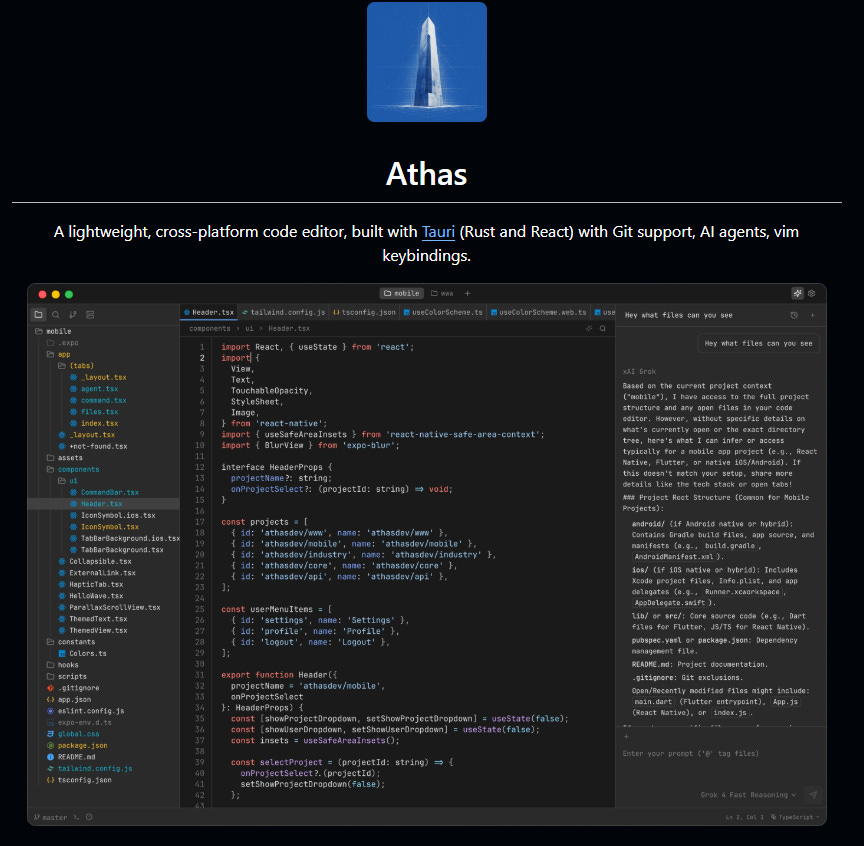
This week we are featuring Athas. It is a lightweight code editor. It works across platforms and comes with Git support, AI agents, and vim style key bindings. You can also plug in external editors like Neovim and Helix. It has a built-in terminal and a simple interface. Check the Athas GitHub repo to know more.
Good to know
I came across a post that walks through what is new in Gemini 3. It covers latest updates like Nano Banana Pro image generation, the new Antigravity dev tool, and how these improvements help developers. It is a quick way to catch up on Google’s latest updates.
GELab-Zero is an open-source GUI agent system. It includes both model and infrastructure. It works like plug and play and built for mobile applications. Check the GELab-Zero GitHub repo for more details.
Kimi offers a slide generator powered by Nano Banana. You can prompt it to create slide decks in seconds. The slides appear in the browser and can be downloaded as a PowerPoint file. Check Kimi’s slide generator to explore more.
Anthropic has acquired Bun, the JavaScript runtime. The goal is to bring faster performance, better stability, and stronger workflows to Claude Code. This lets Anthropic build deeper coding features on top of a runtime they now control. Check Anthropic’s updates to know more.
OpenAI introduced a new method called confessions. A confession is a self-report where the model tells how well it followed the instruction. The goal is to make the model share what it actually did, even when it takes shortcuts. If you are exploring AI safety, this post is worth a read.
Notable FYIs
Razorpay has launched an official node for n8n. You can now plug Razorpay into any n8n workflow with more than twelve ready actions. This makes it easy to build chat apps with payment links and other automated flows. Check the Razorpay n8n integration to explore more.
MongoDB now supports Search and Vector Search in both Community and Enterprise editions. You get full text, semantic, and vector search inside the database with no extra systems to manage. No need for a separate vector DB. Check MongoDB’s latest feature on text search, fuzzy search, semantic search, and vector search.
GitHub has released an open-source annotation toolkit to make design handoff clearer. Designers and developers often lose small details during handoff, which leads to bugs later. This toolkit lets teams add comments and notes right on the design, so developers can build the right thing with less friction. Check the toolkit to know more.
I came across a guide that shows how to use Nano Banana Pro in a better way. It explains how to write good prompts, how to ground images with Google Search, and how to get clean text and stable characters in your images. Check the Nano Banana Pro guide to learn more.
Reports say OpenAI is working on a new model called Garlic. Early tests show strong coding and reasoning performance, even against Gemini 3 and Claude Opus 4.5. This comes as OpenAI declares a “code red” to improve ChatGPT. Garlic may ship as GPT-5.2 or GPT-5.5 next year. Check the full report to know more.
That’s it from us with this edition. We hope you are going away with a ton of new information. Lastly, share this newsletter with your colleagues and pals if you find it valuable. A subscription to the newsletter will be awesome if you are reading it for the first time.